The U.S. nuclear regulatory framework has long been criticized as one of the biggest obstacles to new reactor deployment. It is now undergoing its most significant modernization in decades.
Under Executive Order 14300 [1] and the bipartisan ADVANCE Act [2], the Nuclear Regulatory Commission (NRC) is rewriting the rules to match regulatory burden to actual risk. A regulatory environment is being built for “safety, scale, and speed” that cuts licensing timelines dramatically and unlocks the full potential of the nuclear renaissance.
The Old Regulatory Reality
The format of legacy licensing pathways, referred to as Part 50 and Part 52, are structured in a way that discourages the deployment of advanced nuclear reactors. Dozens of requirements within the regulatory paths are only applicable to large, light-water reactors (LWRs), which make up the existing commercial U.S. fleet. Developers pushing any design other than LWRs require endless exceptions and special considerations that can add years to the licensing process.
The legacy pathways also include relatively treacherous public hearing processes and National Environmental Policy Act (NEPA) reviews that offer endless opportunities for anti-nuclear activists to protest and cause significant multi-year delays.
Part 53: Technology-Inclusive Licensing for Advanced Reactors
Effective April 29, 2026, the NRC’s new Part 53 rule [3] creates the first major update to reactor licensing standards since the 1950s. Part 53 is a risk-informed and technology-inclusive framework specifically tailored to advanced reactor designs other than LWRs.
Developers no longer need to seek exemptions from unrelated LWR requirements. Instead, Part 53 allows applicants to achieve licensing for their reactors on significantly reduced timelines and at a lower cost. An assessment performed by the NRC [4] of the potential impacts of the new pathway include:
- Tens of thousands of hours of labor savings by both NRC staff and licensee employees for preparation and evaluation of license applications.
- Thousands of hours of labor savings for repetitive assessments such as earthquake engineering and aircraft impact assessments
Part 57: Right-Sizing Regulation for Microreactors and Low-Consequence Designs
Announced in late April 2026, the proposed Part 57 framework [5] takes risk-proportional regulation even further. Tailored for microreactors, which are usually under 20 megawatts (MW), it introduces:
- Fleet licensing for identical modules rather than reviewing each unit individually
- Simplified environmental reviews and flexible siting
- Early construction authorizations
- Manufacturing licenses for factory-built reactors
The NRC projects construction permits and operating licenses could now be issued in as little as 6 - 12 months. The rule is also expected to save $3.76 - $11.84 billion by slashing exemption requests and streamlining reviews. [5]
GEIS: Streamlining Environmental Reviews
Complementing these licensing reforms, the NRC finalized its new Generic Environmental Impact Statement (GEIS) [7] for new nuclear reactors in April 2026. The GEIS identifies environmental impacts common to new reactors, allowing the NRC to focus future reviews only on truly project-specific issues.
The impact is immediate and substantial, with up to 40% savings in staff effort per application (6,500 hours), nearly doubling the agency’s capacity to process more licenses simultaneously [8].
Why This Matters for Investors
These reforms are significant, representing a wholesale cultural and procedural shift at the NRC. Combined with executive orders, bipartisan legislation, and surging private-sector demand from tech giants, the U.S. is positioning itself to match (and potentially lead) the pace of nuclear deployment seen in countries like China and France.
For the nuclear value chain represented in the Range Nuclear Renaissance Index ETF (NUKZ), faster licensing means:
- Quicker revenue for advanced reactor developers (Advanced Reactors)
- Accelerated contracts for construction and engineering firms (Construction & Services)
- Stronger economics for utilities securing long-term power purchase agreements (Utilities)
- Increased demand across the fuel cycle as new builds move forward (Fuel)
NUKZ was purpose-built for exactly this moment.
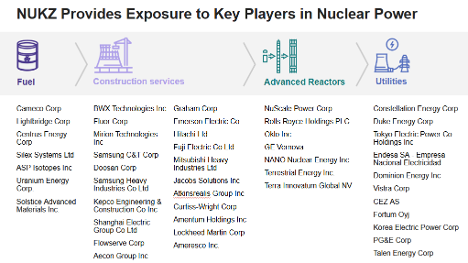
To view the fund’s complete list of holdings, click here. >> Holdings subject to change.
Sources:
[1] Executive Order 14300 https://www.federalregister.gov/documents/2025/05/29/2025-09798/ordering-the-reform-of-the-nuclear-regulatory-commission
[2] ADVANCE Act https://www.congress.gov/118/plaws/publ67/PLAW-118publ67.pdf
[3] 10 CFR Part 53 https://www.ecfr.gov/current/title-10/chapter-I/part-53
[4] Regulatory Analysis for the Final Rule: Risk-Informed, Technology-Inclusive Regulatory Framework for Advanced Reactors https://www.nrc.gov/docs/ML2604/ML26042A230.pdf
[5] Licensing Requirements for Microreactors and Other Reactors With Comparable Risk Profiles https://www.federalregister.gov/documents/2026/05/01/2026-08550/licensing-requirements-for-microreactors-and-other-reactors-with-comparable-risk-profiles
[6] NRC Proposes a New Licensing Framework to Accelerate Safe, High-Volume Deployment of Microreactors https://www.nrc.gov/sites/default/files/cdn/doc-collection-news/2026/26-047.pdf
[7] Generic Environmental Impact Statement for Licensing of New Nuclear Reactors https://www.federalregister.gov/documents/2026/04/24/2026-08015/generic-environmental-impact-statement-for-licensing-of-new-nuclear-reactors
[8] Public Meeting – Draft New Reactor Generic Environmental Impact Statement and Proposed Rule https://www.nrc.gov/docs/ML2428/ML24284A346.pdf
Disclosures:
Investing involves risk, including possible loss of principal. There is no guarantee the Funds will achieve their stated investment objectives. Carefully consider the investment objectives, risks, charges, and expenses. This and other important information can be found in the Funds' prospectuses, which should be read carefully before investing and can be obtained by visiting www.rangeetfs.com/investor-materials, or by calling 1-800-617-0004.
Investments in the energy industry are subject to significant volatility due to changes in commodity prices. Additional risks include changes in exchange rates, government regulation, world events, economic and political conditions in the countries where energy companies are located or do business, and risks for environmental damage claims.
The Fund is non-diversified. Its concentration in an industry or sector can increase the impact of, and potential losses associated with, the risks from investing in those industries/sectors.
Nuclear companies may be subject to substantial government regulation and contractual fixed pricing, which may increase the cost of doing business and limit the earnings of these companies. A significant portion of revenues of nuclear companies depends on a relatively small number of customers, including governmental entities and utilities. As a result, governmental budget constraints may have a material adverse effect on the stock prices of companies in this sub-industry.
International investments may involve risk of capital loss from unfavorable fluctuation in currency values, from differences in generally accepted accounting principles or from social, economic or political instability in other nations. Emerging markets involve heightened risks related to the same factors as well as increased volatility and lower trading volume. Investments in smaller companies typically exhibit higher volatility.
The Fund may invest in securities denominated in foreign currencies. Because the Fund's NAV is determined in U.S. dollars, the Fund's NAV could decline if currencies of the underlying securities depreciate against the U.S. dollar or if there are delays or limits on repatriation of such currencies. Currency exchange rates can be very volatile and can change quickly and unpredictably.
Diversification may not protect against market risk.
Exchange Traded Concepts, LLC serves as the investment advisor of the funds. NUKZ and COAL ETFs are distributed by SEI Investments Distribution Co. (SIDCO, 1 Freedom Valley Drive, Oaks, PA 19456), which is not affiliated with Exchange Traded Concepts, LLC or any of its affiliates.

