Why the Atom’s Second Act Is Accelerating
The phrase “nuclear renaissance” has been circulating for two decades. But until recently, it felt more like aspiration than reality. Today, the convergence of surging electricity demand, geopolitical pressure, and advancing reactor technology has changed the conversation. As The Nuclear Review put it in a recent post:
This is not the beginning of a renaissance, it is the middle of one. [1]
“The Reactors are Coming”
In NR-12: The Reactors Are Coming, the Nuclear Review notes that what once seemed like distant plans is now becoming concrete. Dozens of small modular reactor (SMR) projects are moving forward globally, and the industry is shifting its language from “if” to “when.” The newsletter emphasizes that the critical difference this time is speed,
The next wave of nuclear will not be built one at a time, it will be manufactured, assembled, and deployed in parallel. [2]
Deployment Timeline: SMRs This Decade
Below is a snapshot of when leading developers are targeting their first small modular reactors to come online. [2]
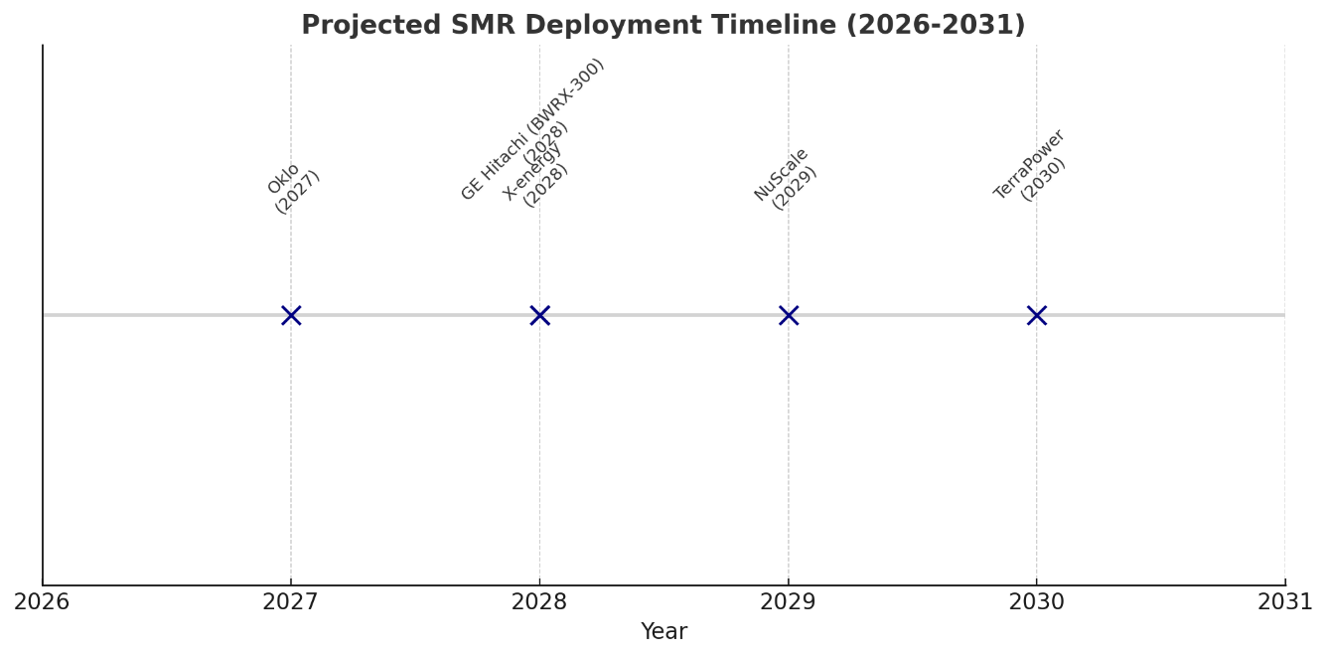
This timeline highlights that commercialization is no longer theoretical. Oklo is aiming for a 2027 launch, followed by X-energy and GE Hitachi’s BWRX-300 in 2028. NuScale and TerraPower are expected to follow in 2029 and 2030. The fact that multiple developers are converging on late-decade deployments marks a sharp break from the past, when nuclear projects often stretched into multi-decade timelines. Instead of bespoke, one-off builds, these designs are intended to be manufactured in factories, shipped in modules, and installed in parallel across multiple sites. That clustering signals a new phase: nuclear moving from one-at-a-time experiments to repeatable, scalable production that can begin to reshape the grid in meaningful ways.
The SMR Race Heats Up
Robert Bryce, in his analysis of the global SMR market, highlights that the field is consolidating. While dozens of designs exist on paper, only a handful are close to commercialization. He points to Oklo, backed by Sam Altman, as an example of a company moving beyond concept into regulatory approvals and financing. [3] This narrowing is good for investors and policymakers alike. It reduces uncertainty, directs capital toward credible players, and helps regulators focus resources where they matter most.
Bryce warns, however, that while enthusiasm is high, execution risk remains. Cost overruns and regulatory hurdles could still derail the build-out if governments fail to streamline processes. Still, the tone is markedly different from just a few years ago.
The SMR race isn’t theoretical anymore. It’s a race with real money, real deadlines, and real stakes. [3]
Policy Tailwinds
Momentum is being reinforced by government support. The U.S. Department of Energy recently selected 11 advanced reactor projects for a pilot program intended to demonstrate small test reactors within a year. [4] The program highlights a shift away from bespoke mega-projects toward modular, repeatable units. In parallel, bipartisan support for the ADVANCE Act is streamlining licensing and providing early-stage funding for advanced reactor developers. [4]
This is not just a U.S. story. From South Korea’s rapid nuclear expansion to the EU’s reclassification of nuclear as sustainable finance, the policy environment is aligning more closely with the scale of the challenge.
Capital is Paying Attention
Markets are following the policy lead. Morgan Stanley projects more than $2.2 trillion in global nuclear investment by 2050, fueled in part by the electricity needs of AI and data centers. [5] Analysts are increasingly highlighting utilities like Talen Energy, PSEG, and Vistra, companies positioned to secure long-term nuclear contracts with industrial and tech-sector buyers. The message is clear: nuclear isn’t just an energy story; it’s an investment thesis.
Why This Time Feels Different
Several factors distinguish today’s momentum from earlier “false starts” in nuclear:
- Scalability: SMRs can be factory-built and installed more quickly than traditional gigawatt-scale reactors [2][3]
- Policy Alignment: From DOE pilots to the ADVANCE Act, governments are clearing long-standing barriers [4]
- Investor Confidence: With institutional capital flowing into nuclear-linked utilities and developers, markets are signaling real confidence [5]
- Cultural Shift: Public opinion in the U.S. has swung in favor of nuclear, with support climbing from 43% to 60% in recent years [6]
On The Horizon
Challenges remain, supply chains, financing, and waste storage, but technology, policy, and capital are more aligned than in decades. As The Nuclear Review noted,
The reactors are not coming someday. They are coming now. [2]
The nuclear renaissance is here. The only question is how fast it can scale.
How May Investors Gain Exposure to Companies in the Nuclear Power Industry?
The Range Nuclear Renaissance Index ETF (NUKZ) seeks to track the performance, before fees and expenses, of the Range Nuclear Renaissance Index. The index aims to track the performance of a portfolio of stocks that are involved in the nuclear fuel and energy industry.
See www.rangeetfs.com/nukz for a full list of positions. Holdings subject to change.
Oklo, Nuscale, Talen Energy Corp. and Vistra Corp. make up 3.61%, 3.04%, 2.10% and 2.65% respectively of NUKZ as of 8/15/2025
Sources
[1] Nuclear Review, State of the Nuclear Renaissance (Substack, 2025)
[2] Nuclear Review, NR-12: The Reactors Are Coming (Substack, 2025)
[3] Robert Bryce, The SMR Race Is Narrowing Fast (Substack, 2025)
[4] Reuters, US selects 11 projects for program to fast-track small nuclear test reactors (2025)
[5] Investopedia, Three Stocks Morgan Stanley Recommends for Playing the Nuclear Renaissance (2025)
[6] Wall Street Journal, Nuclear power is having a pop-culture moment (2025)
Risk Disclosures:
Carefully consider the Fund's investment objectives, risk factors, charges and expenses before investing. This and additional information can be found in the Fund's full or summary prospectus, which may be obtained by visiting www.rangeetfs.com/nukz. Read it carefully before investing or sending money.
Investing involves risk, including possible loss of principal. There is no guarantee the Funds will achieve their stated investment objectives.
Investments in the energy industry are subject to significant volatility due to changes in commodity prices. Additional risks include changes in exchange rates, government regulation, world events, economic and political conditions in the countries where energy companies are located or do business, and risks for environmental damage claims.
The Fund is non-diversified. Its concentration in an industry or sector can increase the impact of, and potential losses associated with, the risks from investing in those industries/sectors.
Nuclear companies may be subject to substantial government regulation and contractual fixed pricing, which may increase the cost of doing business and limit the earnings of these companies. A significant portion of revenues of nuclear companies depends on a relatively small number of customers, including governmental entities and utilities. As a result, governmental budget constraints may have a material adverse effect on the stock prices of companies in this sub-industry.
International investments may involve risk of capital loss from unfavorable fluctuation in currency values, from differences in generally accepted accounting principles or from social, economic or political instability in other nations. Emerging markets involve heightened risks related to the same factors as well as increased volatility and lower trading volume. Investments in smaller companies typically exhibit higher volatility.
The Fund may invest in securities denominated in foreign currencies. Because the Fund's NAV is determined in U.S. dollars, the Fund's NAV could decline if currencies of the underlying securities depreciate against the U.S. dollar or if there are delays or limits on repatriation of such currencies. Currency exchange rates can be very volatile and can change quickly and unpredictably.
Because the Fund is new, investors in the Fund bear the risk that the Fund may not be successful in implementing its investment strategy, may not employ a successful investment strategy, or may fail to attract sufficient assets under management to realize economies of scale, any of which could result in the Fund being liquidated at any time without shareholder approval and at a time that may not be favorable for all shareholders. Such liquidation could have negative tax consequences for shareholders and will cause shareholders to incur expenses of liquidation.
The Fund is a recently organized investment company with no operating history. As a result, prospective investors have no track record or history on which to base their investment decision. Moreover, investors will not be able to evaluate the Fund against one or more comparable funds on the basis of relative performance until the Funds has established a track record.
Exchange Traded Concepts, LLC serves as the investment advisor of the funds. NUKZ, COAL, and ETFs are distributed by SEI Investments Distribution Co. (SIDCO, 1 Freedom Valley Drive, Oaks, PA 19456), which is not affiliated with Exchange Traded Concepts, LLC, or any of its affiliates.

