In an era where AI and data centers are projected to drive electricity demand growth not seen in decades, reliable, low-carbon baseload power is at a premium. Nuclear power increasingly stands out because of its safety record, not in spite of it. When evaluated through quantitative metrics rather than outdated perceptions, nuclear reactors demonstrate one of the strongest safety records of any energy technology.
Newer designs push that performance even higher, reducing both the probability and consequences of accidents to levels that meaningfully de-risk projects for investors and stakeholders.
Why Nuclear Power Is Fundamentally Safe
Nuclear fission is a controlled chain reaction governed by well-understood physics. Reactors are engineered with multiple, independent layers of protection, a philosophy called “defense-in-depth.”
Imagine concentric barriers: ceramic fuel pellets trap most fission products; these sit inside metal cladding; that assembly lives in a thick steel pressure vessel; and the vessel is enclosed in a reinforced concrete containment structure designed to withstand extreme internal pressures or external impacts.
Beyond physical barriers, reactors exploit inherent properties of physics. Most designs have a “negative temperature coefficient of reactivity.” If the core temperature rises, the chain reaction naturally slows or stops, providing automatic self-regulation without any mechanical action. This is analogous to a thermostat that prevents overheating even if the control system fails.
Stringent regulatory frameworks from the U.S. Nuclear Regulatory Commission (NRC), impose conservative margins, exhaustive risk assessments, redundant systems, and continuous monitoring. Operators train rigorously, and plants undergo frequent inspections. Over more than 70 years of commercial operation and roughly 18,000 reactor-years worldwide, the industry has compiled an exceptional track record.1
The three significant accidents (Three Mile Island in 1979, Chernobyl in 1986, and Fukushima in 2011) occurred in designs or under conditions that do not represent today’s Western fleet. Lessons from each have driven systematic improvements in backup power, flooding protection, and operator training.
Metrics That Quantify the Safety Record
Death rates per unit of electricity produced provide one of the clearest comparisons across energy sources. According to Our World in Data’s synthesis of accident and air-pollution data 2:
- Nuclear: approximately 0.03 deaths per terawatt-hour (TWh)
- Natural Gas: 2.82 deaths per TWh
- Wind: 0.04 deaths per TWh
- Solar: 0.02 deaths per TWh
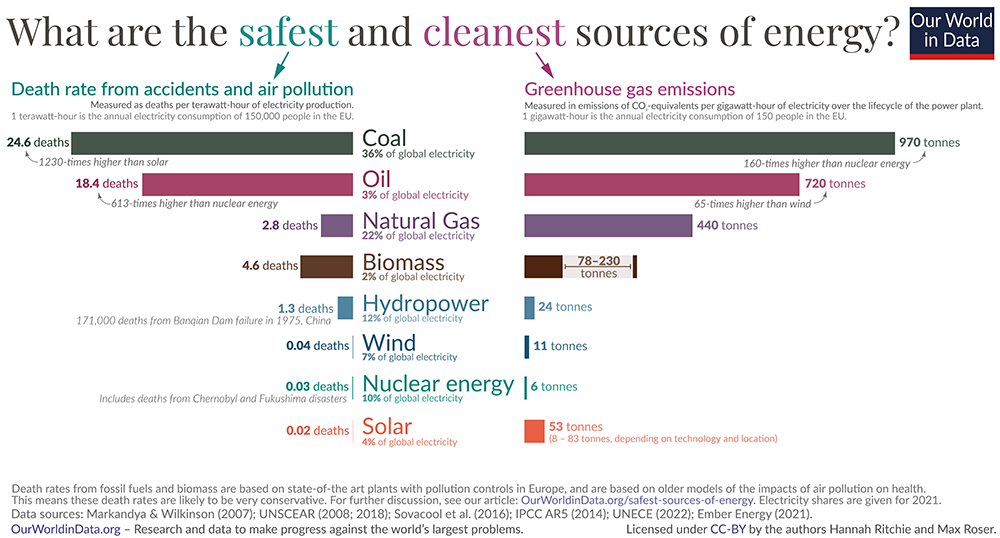
Nuclear power thus results in about 90 times fewer deaths than natural gas when including all historical accidents (Chernobyl and Fukushima estimates) and modeled long-term effects.
For perspective, a mid-sized city or large industrial load consuming 1 TWh per year would, on average, see roughly one death every 33 years across the entire global nuclear fleet’s historical output.
Operational performance reinforces the picture. The U.S. nuclear fleet has sustained capacity factors above 90% in recent years (recently averaging around 92% 3), delivering near-constant output with minimal downtime. This reliability translates directly into predictable revenue for owners and far less exposure to fuel-price volatility or weather-driven intermittency than other sources.
Critically, there have been no radiation-related public fatalities from Western commercial reactors in normal operation or from the contained events at Three Mile Island and Fukushima. The industry’s safety culture and regulatory framework have produced a risk profile that continues to improve.
Generation IV Designs: An Even Safer Paradigm
Generation IV reactors and many advanced small modular reactors (SMRs) build on the passive safety already achieved in Gen III+ plants and take it further through inherent design features. Passive systems, already proven in the AP1000 and NuScale designs, use gravity, natural convection, and stored energy to remove heat indefinitely without electrical power, pumps, or operator intervention. These “walk-away safe” characteristics would have prevented core damage at Fukushima, where the primary failure was loss of active cooling after the tsunami.
Gen IV concepts amplify these advantages:
- Many operate at or near atmospheric pressure, eliminating accident scenarios that drove older design-basis events.
- Advanced coolants (helium, liquid sodium, or molten salts) provide high thermal margins and, in some cases, self-regulating properties.
- Robust fuel forms such as TRISO particles in high-temperature gas reactors can withstand temperatures well above 1,600°C without releasing dangerous products.
- Smaller cores in SMRs and microreactors produce less heat, making passive cooling simpler and more robust. Factory fabrication further improves quality control over traditional field construction.
International Gen IV goals explicitly target not only very low core damage likelihood and degree but also the practical elimination of scenarios requiring large off-site releases. Many designs aim to ensure that even in extreme events, the plant can remain safe without public evacuation or long-term relocation, dramatically shrinking the tail risks that historically concerned communities and investors alike.
What This Means for Investors
Safety performance directly influences project economics and risk-adjusted returns. Designs with strong, demonstrated safety cases benefit from more predictable regulatory timelines and lower likelihood of costly delays or redesigns. High capacity factors support stable cash flows over 60–80-year asset lives. Reduced probability and consequence of severe accidents translate into lower tail-risk exposure, important for insurance structuring, financing terms, and long-term valuation.
As hyperscalers and data center developers increasingly pursue direct nuclear offtake agreements for reliable 24/7 carbon-free power, the premium on safety and operational certainty may become a competitive advantage. Public and policy support for nuclear is strengthening 4 precisely because the data shows an exceptionally safe, scalable, firm clean-energy resource.
In summary, nuclear power’s safety is not theoretical or aspirational. It is measured, documented, and improving with each generation of technology. For capital allocators seeking potentially resilient exposure to the energy transition, the combination of proven low risk, high reliability, and advancing inherent safety features may make nuclear one of the most compelling infrastructure opportunities available today.
Sources:
1. World Nuclear Association. "Safety of Nuclear Power Reactors." World Nuclear Association. Accessed June 10, 2026.
2. Ritchie, Hannah. "What Are the Safest and Cleanest Sources of Energy?" Our World in Data, February 10, 2020.
3. World Nuclear Association. "Nuclear Power in the USA." World Nuclear Association. Accessed June 10, 2026.
4. Brenan, Megan. "Less Support in U.S. for Solar, Wind Energy; More for Nuclear." Gallup, April 22, 2026.
Disclosures:
Investing involves risk, including possible loss of principal. There is no guarantee the Funds will achieve their stated investment objectives. Carefully consider the investment objectives, risks, charges, and expenses. This and other important information can be found in the Funds' prospectuses, which should be read carefully before investing and can be obtained by visiting www.rangeetfs.com/investor-materials, or by calling 1-800-617-0004.
Investments in the energy industry are subject to significant volatility due to changes in commodity prices. Additional risks include changes in exchange rates, government regulation, world events, economic and political conditions in the countries where energy companies are located or do business, and risks for environmental damage claims.
The Fund is non-diversified. Its concentration in an industry or sector can increase the impact of, and potential losses associated with, the risks from investing in those industries/sectors.
Nuclear companies may be subject to substantial government regulation and contractual fixed pricing, which may increase the cost of doing business and limit the earnings of these companies. A significant portion of revenues of nuclear companies depends on a relatively small number of customers, including governmental entities and utilities. As a result, governmental budget constraints may have a material adverse effect on the stock prices of companies in this sub-industry.
International investments may involve risk of capital loss from unfavorable fluctuation in currency values, from differences in generally accepted accounting principles or from social, economic or political instability in other nations. Emerging markets involve heightened risks related to the same factors as well as increased volatility and lower trading volume. Investments in smaller companies typically exhibit higher volatility.
The Fund may invest in securities denominated in foreign currencies. Because the Fund's NAV is determined in U.S. dollars, the Fund's NAV could decline if currencies of the underlying securities depreciate against the U.S. dollar or if there are delays or limits on repatriation of such currencies. Currency exchange rates can be very volatile and can change quickly and unpredictably.
Diversification may not protect against market risk.
Exchange Traded Concepts, LLC serves as the investment advisor of the funds. NUKZ and COAL ETFs are distributed by SEI Investments Distribution Co. (SIDCO, 1 Freedom Valley Drive, Oaks, PA 19456), which is not affiliated with Exchange Traded Concepts, LLC or any of its affiliates.

