In the ever-evolving landscape of artificial intelligence (AI), the relationship between technological advancement and resource consumption reveals a fascinating paradox: as efficiency increases, so too does demand. This phenomenon, known as Jevons Paradox, underscores the unintended consequence of AI's rapid adoption. More AI use inevitably leads to more power consumption.
The Cost of Compute: Driving AI Adoption
A dramatic reduction in the cost of compute has catalyzed AI adoption across industries. Over the past six years, the capital cost of data centers, measured per teraFLOP, has fallen by nearly 90% [1]. This cost efficiency has not only spurred AI adoption but also expanded its applications, particularly in AI inference. Unlike training models, which require massive computational resources upfront, inference handles the deployment and real-world operation of AI, and its demand is set to grow exponentially.
The introduction of models like DeepSeek-R1-zero, trained at a fraction of the cost of predecessors, exemplifies this trend. With training costs as low as $5.6 million, compared to Meta's 405B LLaMA model’s $30.8 million, DeepSeek illustrates how efficiency accelerates accessibility. As training becomes less prohibitive, the resulting increase in AI-enabled products and services feeds a cycle of growing demand for computational power.
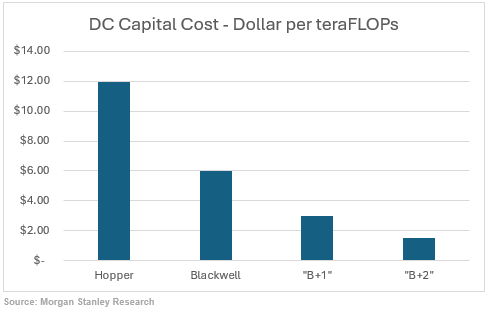
[2] The X-asis of the above chart represents generations of AI computing hardware architectures.
The Expansion of AI Infrastructure
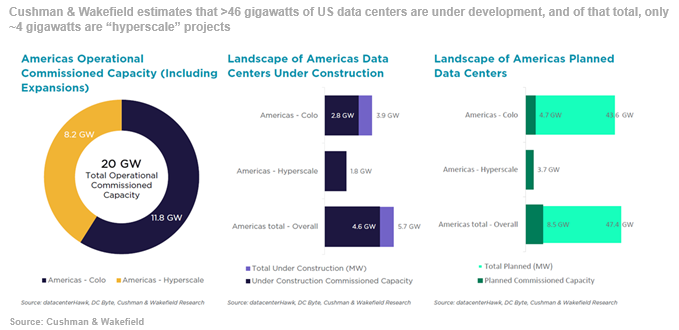
The United States is at the forefront of this growth, with more than 47 gigawatts of data centers under development. However, the mix between training-focused and inference-focused facilities is crucial. While hyperscale projects like Meta's 2,000-megawatt Louisiana facility dominate headlines, the majority of new developments are smaller inference-focused colocation centers. These facilities, often ranging between 100 and 300 megawatts, reflect the surge in real-world AI applications and their associated power needs.
Projects like Stargate, a $500 billion initiative supported by companies such as OpenAI, NVIDIA, and Microsoft, aim to create vertically scaled GPU clusters for foundational model training. However, the broader data center pipeline suggests a pivot toward inference-driven growth, with implications for utilities, energy providers, and infrastructure developers.
AI's Energy Appetite: A Multi-Faceted Demand
AI's rapid growth is reshaping energy markets. The deployment of AI chips, 55% of which are currently in the U.S., requires robust energy infrastructure. The increasing reliance on renewables, nuclear power, and natural gas highlights the effort to balance growing demand with sustainability. Notably, many regulated utilities have yet to account for data center growth in their forecasts, presenting upside opportunities for power providers.
Beyond AI, other factors such as electrification, EV adoption, and onshoring of manufacturing contribute to an anticipated 1.8% compound annual growth rate in electricity demand from 2025 to 2030. While AI accounts for only 0.8% of this growth, its influence on power markets is disproportionately large due to the scale and intensity of data center needs.
Efficiency Begets Demand
Jevons Paradox encapsulates the core challenge of AI growth. As advancements make AI more accessible and affordable, demand for computational power accelerates. This dynamic creates a positive feedback loop, where efficiency drives adoption, and adoption drives power consumption. Companies like Microsoft and Meta, with multi-billion-dollar commitments to AI infrastructure, are indicative of this cycle.
The introduction of efficient models like DeepSeek not only democratizes AI but also intensifies its resource demands. As data centers expand and power needs grow, the interplay between AI and energy becomes increasingly central to technological progress.
AI’s Unstoppable Expansion
The story of AI is one of boundless potential paired with immense infrastructure demands. From DeepSeek's groundbreaking efficiency to the burgeoning U.S. data center pipeline, the trajectory seems clear. AI will continue to reshape industries and energy systems alike. Jevons Paradox reminds us that efficiency is not a panacea; rather, it is a catalyst for even greater demand. In this era of AI-driven innovation, the quest for more intelligent solutions will always be powered by an insatiable need for energy.
Consider exploring Range's ETFs to strengthen your position in the evolving energy sector.
The Range Global Coal Index ETF
The Range Global Coal Index ETF (COAL) seeks to provide investment results that, before fees and expenses, correspond generally to the total return performance of the Range Global Coal Index. The Index aims to track the performance of a portfolio of stocks that are involved in the metallurgical and thermal coal industry.
The Range Nuclear Renaissance Index ETF
The Range Nuclear Renaissance Index ETF (NUKZ) is designed to provide exposure to companies that are involved in the following segments: Advanced Reactor, Utilities, Construction & Services, and Fuel.
The Range Global LNG Ecosystem Index ETF
The Range Global LNG Ecosystem Index ETF (LNGZ) aims to provide investors with exposure to companies that are involved in the Liquefied Natural Gas (“LNG”) ecosystem. Companies classified as an “LNG Ecosystem” are likely engaged in one of the following areas: production, exploration, development, transportation, and distribution.
The Range Global Offshore Oil Services Index ETF
The Range Global Offshore Oil Services Index ETF (OFOS) is designed to provide exposure to companies that are involved in the offshore oil services ecosystem. Companies classified as “Offshore Oil Services” are likely engaged in one of the following areas: production, exploration, development, transportation, and distribution.
For a full list of COAL holdings, please click here.
For a full list of NUKZ holdings, please click here.
For a full list of LNGZ holdings, please click here.
For a full list of OFOS holdings, please click here.
Holdings subject to change.
[1] All data sourced from: Byrd, Stephen C., Brenda Duverce, David Arcaro, CFA, Andrew S. Percoco, Christopher Snyder, CFA, Angel Castillo, et al. Future of Energy: DeepSeek - US Power Infrastructure Implications. North America, January 28, 2025. PDF
Risk Disclosures:
Carefully consider the Fund's investment objectives, risk factors, charges and expenses before investing. This and additional information can be found in the Fund's full or summary prospectus, which may be obtained by visiting www.rangeetfs.com/investor-materials. Read it carefully before investing or sending money.
Investing involves risk, including possible loss of principal. There is no guarantee the Funds will achieve their stated investment objectives.
Investments in the energy industry are subject to significant volatility due to changes in commodity prices. Additional risks include changes in exchange rates, government regulation, world events, economic and political conditions in the countries where energy companies are located or do business, and risks for environmental damage claims.
The Funds are non-diversified. Their concentration in an industry or sector can increase the impact of, and potential losses associated with, the risks from investing in those industries/sectors.
International investments may involve risk of capital loss from unfavorable fluctuation in currency values, from differences in generally accepted accounting principles or from social, economic or political instability in other nations. Emerging markets involve heightened risks related to the same factors as well as increased volatility and lower trading volume. Investments in smaller companies typically exhibit higher volatility.
The Funds may invest in securities denominated in foreign currencies. Because the Funds' NAV is determined in U.S. dollars, the Funds' NAV could decline if currencies of the underlying securities depreciate against the U.S. dollar or if there are delays or limits on repatriation of such currencies. Currency exchange rates can be very volatile and can change quickly and unpredictably.
Because the Funds are new, investors in the Funds bear the risk that the Fund may not be successful in implementing their investment strategy, may not employ a successful investment strategy, or may fail to attract sufficient assets under management to realize economies of scale, any of which could result in the Funds being liquidated at any time without shareholder approval and at a time that may not be favorable for all shareholders. Such liquidation could have negative tax consequences for shareholders and will cause shareholders to incur expenses of liquidation.
The Funds are a recently organized investment company with no operating history. As a result, prospective investors have no track record or history on which to base their investment decision. Moreover, investors will not be able to evaluate the Funds against one or more comparable funds on the basis of relative performance until the Funds has established a track record
Exchange Traded Concepts, LLC serves as the investment advisor of the funds. NUKZ, LNGZ, COAL, and OFOS ETFs are distributed by SEI Investments Distribution Co. (SIDCO, 1 Freedom Valley Drive, Oaks, PA 19456), which is not affiliated with Exchange Traded Concepts, LLC, or any of its affiliates

