As the world accelerates its transition toward cleaner energy solutions, coal remains an unexpected mainstay in the global energy landscape. According to the International Energy Agency (IEA), global coal demand will reach an unprecedented 8.77 billion metric tons in 2024, driven by a mix of industrial growth, energy security needs, and the limitations of renewable energy scalability [1]. This milestone challenges the assumption that coal is a relic of the past, particularly as traditional fuels like wood also see a resurgence in certain regions, highlighting the uneven progress of the energy transition [2].
A Pillar for Emerging Economies
Coal’s resilience is most evident in emerging markets, where its affordability, abundance, and reliability make it indispensable. China and India, the world’s largest coal consumers, exemplify this trend. These nations face a delicate balancing act as they strive to achieve ambitious renewable energy goals while continuing to depend on coal to fuel their rapidly industrializing economies. In India, the surge in manufacturing exports, including a 143 percent rise in semiconductor shipments and a 70 percent increase in mechanical machinery, highlights the growing demand for electricity to power its expanding industrial base [3]. Coal-fired power plants remain essential for grid stability, particularly during peak demand periods or when renewable energy sources underperform because of weather variability. The vast scale of their industrial ambitions ensures that coal will remain a critical component of their energy portfolios for the foreseeable future.
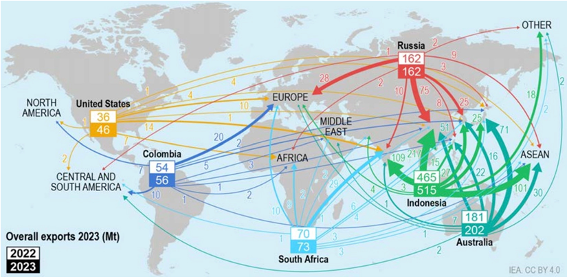 Source: IEA Coal 2024
Even in regions with ambitious decarbonization agendas, coal has proven surprisingly durable. Advanced economies like the United States and the European Union have reduced their reliance on coal, but these reductions have been slower than anticipated. Volatile natural gas prices, geopolitical disruptions, and energy security concerns have driven renewed interest in coal as a reliable backup power source. This dynamic reinforces coal’s continued relevance as a “safety net” in transitioning energy systems [2].
The Uneven Energy Transition
Coal’s persistence highlights the broader challenges of the global energy transition. As John Kemp notes in his analysis of the rise in wood fuel consumption, traditional energy sources are still widely used in many regions, underscoring the gaps in renewable energy adoption [4]. The increased reliance on wood fuels in parts of the world is a stark reminder that the energy transition is far from universal. Similarly, coal remains a critical resource in countries where modern energy infrastructure is either underdeveloped or unable to meet surging demand.
Southeast Asia and parts of Africa are illustrative examples. These regions face significant hurdles in scaling renewable energy technologies quickly enough to replace coal. Until renewable infrastructure catches up, coal offers a pragmatic solution for powering economic growth while meeting the immediate needs of energy reliability and affordability [2].
Shifts in the Global Coal Market
The global coal market is dynamic, evolving in response to shifting economic and geopolitical landscapes. Indonesia and Australia remain dominant exporters, playing a critical role in meeting the rising energy demands of industrializing nations. At the same time, new players such as Vietnam are increasing their production capacity to address regional needs. Price volatility in both thermal and metallurgical coal markets adds another layer of complexity, reflecting the interplay of environmental policies, geopolitical tensions, and shifting trade dynamics.
This volatility is particularly pronounced in developing economies, where energy access and affordability often take precedence over environmental considerations. The need for coal as a stopgap solution in these regions further reinforces its enduring role in the global energy mix [2].
Looking Ahead
As the global energy sector approaches 2025, it stands at a critical crossroads. The rapid scaling of renewable technologies has not yet bridged the gap between ambition and reality, particularly in developing regions. Coal’s enduring presence alongside a resurgence in traditional fuels like wood highlights the challenges of balancing sustainability, energy security, and economic growth.
For policymakers, this dual reality presents an urgent need to adopt region-specific strategies that account for the varied pace of energy transitions across the globe. For investors and industry stakeholders, it underscores the importance of pragmatic approaches that align short-term realities with long-term goals. Coal’s continued role is not just a story of resilience, it underscores the profound complexities and challenges involved in transforming the global energy landscape.
How May Investors Gain Exposure to Companies in the Coal Industry?
The Range Global Coal Index ETF
The Range Global Coal Index ETF (COAL) seeks to provide investment results that, before fees and expenses, correspond generally to the total return performance of the Range Global Coal Index. The Index aims to track the performance of a portfolio of stocks that are involved in the met and thermal coal industry.
[1] International Energy Agency. Coal 2024: Analysis and Forecast to 2028. 2024, https://iea.blob.core.windows.net/assets/a1ee7b75-d555-49b6-b580-17d64ccc8365/Coal2024.pdf.
[2] Kemp, John. Global Coal Production and Electricity Generation: Selected Indicators. December 2024.
[3] Kashyap, Krn. "How India Is Emerging as a Production Hub for Global Exports." Forbes, December 21, 2023. https://www.forbes.com/sites/krnkashyap/2023/12/21/how-india-is-emerging-as-a-production-hub-for-global-exports/?amp;utm_medium=email&utm_source=substack
[4] Kemp, John. Rising wood fuel consumption shows limits of energy transition. JKempEnergy, Dec. 2024, https://jkempenergy.com/2024/12/11/rising-wood-fuel-consumption-shows-limits-of-energy-transition/
Risk Disclosures:
Carefully consider the Fund's investment objectives, risk factors, charges and expenses before investing. This and additional information can be found in the Fund's full or summary prospectus, which may be obtained by visiting www.rangeetfs.com/coal. Read it carefully before investing or sending money.
Investing involves risk, including possible loss of principal. There is no guarantee the Funds will achieve their stated investment objectives.
Investments in the energy industry are subject to significant volatility due to changes in commodity prices. Additional risks include changes in exchange rates, government regulation, world events, economic and political conditions in the countries where energy companies are located or do business, and risks for environmental damage claims.
The Fund is non-diversified. Its concentration in an industry or sector can increase the impact of, and potential losses associated with, the risks from investing in those industries/sectors.
International investments may involve risk of capital loss from unfavorable fluctuation in currency values, from differences in generally accepted accounting principles or from social, economic or political instability in other nations. Emerging markets involve heightened risks related to the same factors as well as increased volatility and lower trading volume. Investments in smaller companies typically exhibit higher volatility.
The Fund may invest in securities denominated in foreign currencies. Because the Fund's NAV is determined in U.S. dollars, the Fund's NAV could decline if currencies of the underlying securities depreciate against the U.S. dollar or if there are delays or limits on repatriation of such currencies. Currency exchange rates can be very volatile and can change quickly and unpredictably.
Because the Fund is new, investors in the Fund bear the risk that the Fund may not be successful in implementing its investment strategy, may not employ a successful investment strategy, or may fail to attract sufficient assets under management to realize economies of scale, any of which could result in the Fund being liquidated at any time without shareholder approval and at a time that may not be favorable for all shareholders. Such liquidation could have negative tax consequences for shareholders and will cause shareholders to incur expenses of liquidation.
The Fund is a recently organized investment company with no operating history. As a result, prospective investors have no track record or history on which to base their investment decision. Moreover, investors will not be able to evaluate the Fund against one or more comparable funds on the basis of relative performance until the Funds has established a track record.
Exchange Traded Concepts, LLC serves as the investment advisor of the funds. NUKZ, LNGZ, COAL, and OFOS ETFs are distributed by SEI Investments Distribution Co. (SIDCO, 1 Freedom Valley Drive, Oaks, PA 19456), which is not affiliated with Exchange Traded Concepts, LLC, or any of its affiliates.

