Since conflict broke out, the de facto closure of the Strait of Hormuz has sent shockwaves through global liquified natural gas (LNG) markets. Asian spot LNG prices have surged roughly 70% to three-year highs, levels that most importers in the Asia-Pacific simply cannot sustain.¹ The result has been swift and predictable: countries are turning back to coal.
Japan, South Korea, China, India, Bangladesh, and most of Southeast Asia are ramping up coal-fired generation to offset gas shortfalls. As Anthony Knutson, global head of coal at Wood Mackenzie, put it, Asian countries are
"opening the tap on coal generation to help offset rising gas prices and supply risk."¹
Coal cannot fully replace lost gas supply, but it provides an immediate and meaningful buffer during what analysts describe as the largest supply disruption in energy market history.³
A Pattern the Market Has Seen Before
This is not the first time a geopolitical shock has forced a hard reset on energy priorities. The Russian invasion of Ukraine in 2022 triggered a similar reckoning where European nations that had been systematically retiring coal capacity suddenly found themselves scrambling to keep the lights on. Energy security, reliability, and affordability moved to the top of the policy agenda almost overnight, and emission commitments were quietly deprioritized.
The lesson from both episodes is consistent: when energy shocks hit, pragmatism overrides ideology. Reliable, affordable power takes precedence. Coal, precisely because of its domestic availability and relative insulation from geopolitical supply chains, becomes the asset of last resort and increasingly, the asset of first resort.
The Numbers Tell the Story
Since the start of the war (February 28, 2026), benchmark Australian coal prices are up approximately 17% through March 27, 2026.2 That compares to a 67% spike in European LNG prices over the same period.² The divergence is instructive. Coal's relative price stability during a period of extreme energy stress is structural. Unlike LNG, which is heavily exposed to chokepoints like the Strait of Hormuz, coal supply chains are geographically diversified and far less vulnerable to a single point of disruption. For energy importers seeking resilience, that quality carries real value.
Coal's Place in the Long-Term Energy Mix
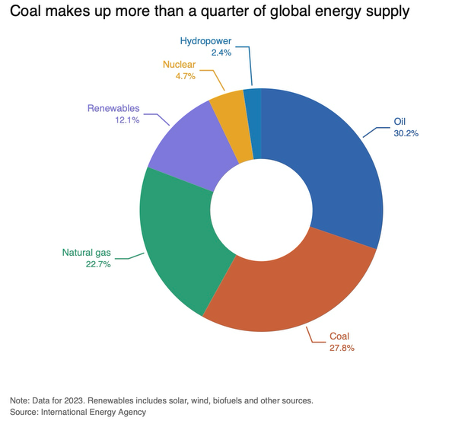
Zooming out, the structural case for coal may be stronger than headlines suggest. Coal currently accounts for nearly 28% of the global energy supply - more than natural gas, and more than all renewables combined.⁴ Global power demand continues to grow, driven by industrialization in Asia and Africa, data center expansion, and electrification across multiple sectors. In that context, coal demand is not declining in absolute terms; it is growing alongside everything else.²
The war in Iran underscores a broader theme that merits attention: a diversification of energy types and suppliers is a strategic imperative. A resilient energy mix requires coal, nuclear, and renewables working in concert, not in competition.
From Geopolitics to Portfolio: COAL ETF
For investors seeking direct exposure to this dynamic, the Range Global Coal Index ETF (COAL) aims to offer a focused vehicle. The index tracks a basket of companies across the global coal value chain - from mining and production to transportation and export infrastructure - providing diversified access to coal ecosystem’s potential upside without single-stock concentration risk.
In an environment where LNG prices are volatile, geopolitical risk premiums are rising, and energy security is reshaping procurement decisions from Tokyo to Berlin, coal equities may stand to benefit from both near-term price momentum and longer-term structural demand. The 17% move in benchmark Australian coal prices since the war's start is consistent with a broader market reassessment of coal's role in global energy supply.
For investors constructing energy allocations, COAL may deserve a closer look. Instead of being a contrarian bet, investing in coal may be a logical reflection of its importance in the global energy mix.
Sources:
[1] Paraskova, Tsvetana. "Asia Burns More Coal as Middle East War Sends LNG Prices to 3-Year Highs." OilPrice.com, March 31, 2026.
[2] Bloomberg News. "Iran War's Gas Supply Shock Pushed Top Consumers Back to Coal." Bloomberg, March 29, 2026.
[3] Wood Mackenzie. "War Is Once Again Reshaping Gas and LNG." Wood Mackenzie, March 2026.
[4] International Energy Agency. World Energy Outlook 2023. Paris: IEA, 2023.
Disclosures:
Investing involves risk, including possible loss of principal. There is no guarantee the Funds will achieve their stated investment objectives. Carefully consider the investment objectives, risks, charges, and expenses. This and other important information can be found in the Funds' prospectuses, which should be read carefully before investing and can be obtained by visiting www.rangeetfs.com/investor-materials, or by calling 1-800-617-0004.
Investments in the energy industry are subject to significant volatility due to changes in commodity prices. Additional risks include changes in exchange rates, government regulation, world events, economic and political conditions in the countries where energy companies are located or do business, and risks for environmental damage claims.
The Fund is non-diversified. Its concentration in an industry or sector can increase the impact of, and potential losses associated with, the risks from investing in those industries/sectors.
International investments may involve risk of capital loss from unfavorable fluctuation in currency values, from differences in generally accepted accounting principles or from social, economic or political instability in other nations. Emerging markets involve heightened risks related to the same factors as well as increased volatility and lower trading volume. Investments in smaller companies typically exhibit higher volatility.
The Fund may invest in securities denominated in foreign currencies. Because the Fund's NAV is determined in U.S. dollars, the Fund's NAV could decline if currencies of the underlying securities depreciate against the U.S. dollar or if there are delays or limits on repatriation of such currencies. Currency exchange rates can be very volatile and can change quickly and unpredictably.
Diversification may not protect against market risk.
Exchange Traded Concepts, LLC serves as the investment advisor of the funds. NUKZ and COAL ETFs are distributed by SEI Investments Distribution Co. (SIDCO, 1 Freedom Valley Drive, Oaks, PA 19456), which is not affiliated with Exchange Traded Concepts, LLC or any of its affiliates.

